You have arrived at the moment when you have to decide whether you are a person who enjoys polka (low commitment, occasional wedding) or a person who is a polka person (higher commitment, owns at least one accordion-related coffee mug). This page is for the second kind. If you are the first kind, no judgment, but you might enjoy the Polka Party page more.
Step 1: Listen to These Eight Songs, In Order
The fastest path to polka literacy. Listen once, ideally with full attention, ideally before eating. Pour a small drink. Try a small dance. We won't tell.
- "Just Because" — Frankie Yankovic, 1947. The Big Bang. Listen for the button-box accordion and the unmistakable Cleveland tempo.
- "Beer Barrel Polka (Roll Out the Barrel)" — The polka National Anthem. You already know it. You did not know you knew it. You do now.
- "Pennsylvania Polka" — Frankie Yankovic's other big one. The Groundhog Day one.
- "Who Stole the Kishka?" — Walter Solek originally, then everyone. The shout-along.
- "In Heaven There Is No Beer" — Yes, you should sing along even if you do not drink beer. The lyrics make this clear.
- "Polka Face" — Weird Al, 2011. The bridge between worlds.
- "Hot Rocks Polka" — Weird Al, 1989. Eight Rolling Stones songs. Listen with someone who hates polka. Watch them convert in real time.
- Any Brave Combo album — ideally Polkasonic (1999). The "this is where polka can go" pivot point.
After these eight, you have a working polka vocabulary. You can speak the language. You may now order from the menu.
Or, if you'd prefer to skip the curation and just let the polka wash over you, hit play below.
Step 2: Learn the Basic Polka Step
The polka step is a 4-beat repeating pattern, hopping slightly on the off-beat:
- Beat 1: Step LEFT foot to the left.
- Beat 2: RIGHT foot meets LEFT (touch or quick close).
- Beat 3: Step LEFT again to the left, with a small hop.
- Beat 4: Hold (or hop briefly on the right foot).
- Repeat on the right side: RIGHT, LEFT, RIGHT, hop.
The official mnemonic is "quick-quick-slow, quick-quick-slow." Some people say "step-step-hop, step-step-hop." Both are correct. Both produce the same dance. The dance does not care which mantra you use.
The closed-position version (with a partner) just adds spinning. Hold your partner in standard ballroom hold (right hand on their back, left hand holds their right hand). Now do the same step, but rotate slightly with each iteration. After about thirty seconds you will be moving in a circle around the room. After about a minute you will be slightly dizzy. After about three minutes you will be a polka person. The transformation is complete.
Or, let someone with actual dance credentials show you. Here, watch:
Step 3 (Optional but Strongly Encouraged): Buy an Accordion
You do not have to play an instrument to be a polka person. You really don't. We promise. But there is no faster path to total commitment than buying an accordion. Here is the entry-level guide:
- For absolute beginners: Get a used Hohner Bravo II 48-bass piano accordion for about $700–$1,200. Or a Chinese-made starter (Parrot, Rambler, Weltmeister budget line) for $400–$700. Avoid anything under $300 — you will get a toy that hurts to play.
- For the committed: A used Hohner Erica or Hohner Corona button accordion for $1,500–$3,000. This is the kind of accordion Tex-Mex bands and a lot of polka pros play.
- For the truly serious: A new Petosa, Castagnari, or Beltuna, $4,000–$15,000. These are the Stradivarii of accordions. Save up. Buy used if you must. Insure them.
- Lessons: YouTube has hundreds of free beginner accordion tutorials. For something more structured, look for a local music school — an accordion teacher in any major American city is rare but exists. Online lesson platforms (ArtistWorks, Tomi Sound's free YouTube series) are excellent.
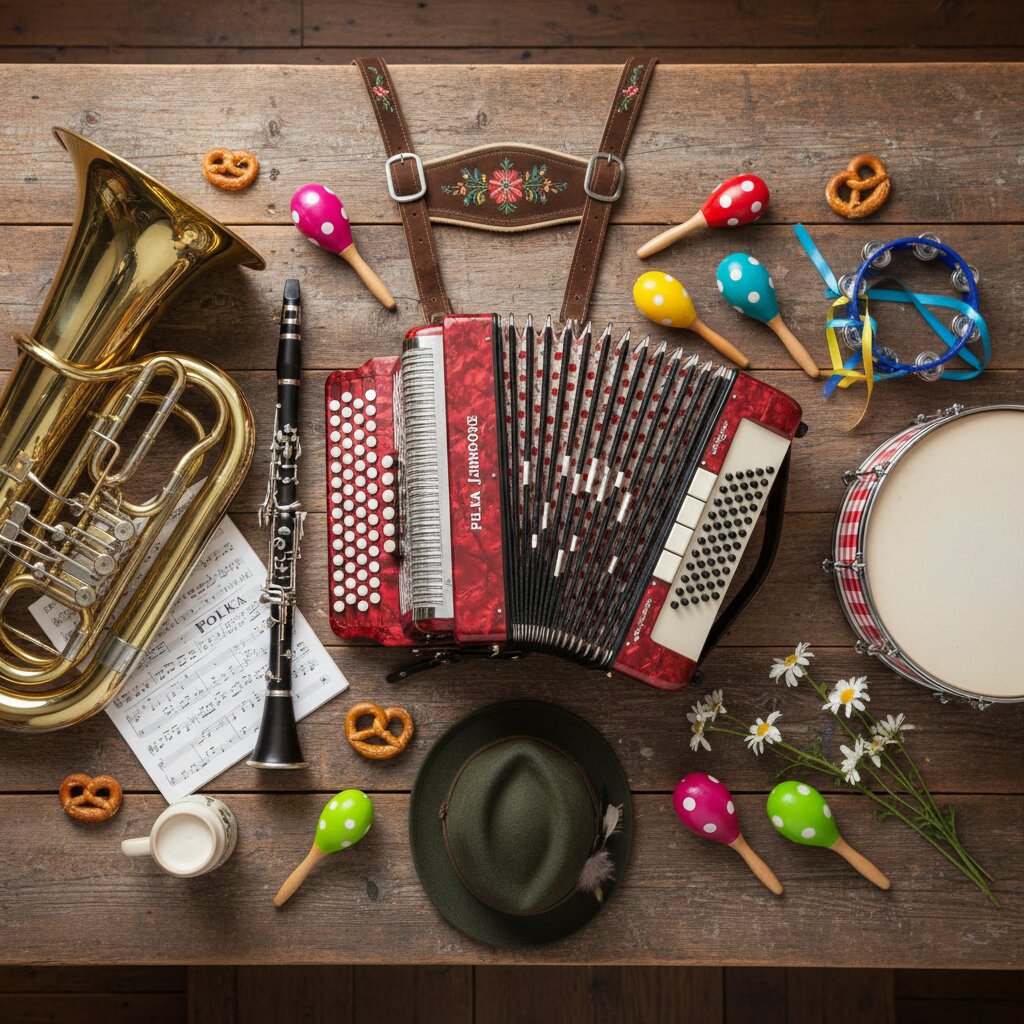 Starter Kit
Step 4: Find Your Local Scene
The polka community is not on Instagram. The polka community is on flyers stapled to the bulletin board at a Croatian church hall in suburban Cleveland. Here is how to find it:
- Look for ethnic churches. Polish, Slovak, Czech, German, Croatian, Slovenian, Ukrainian. Their summer festivals are polka motherlodes.
- Look for "fraternal lodges." The Polish National Alliance (PNA), Sons of Norway, Sokol gymnastic associations, Polish Falcons, German-American clubs. Many have weekly or monthly dances.
- Search county fairs and Octoberfests. Almost every Midwestern county fair has at least one polka act. Octoberfests are obvious but very effective.
- Polka radio stations. WKTL Struthers, Ohio. WCPN. Polka Jammer Network (online). They post calendars of local events.
- Polka festivals. See the festivals list on the Resources page.
Step 5 (Sartorial): What to Wear
See the wardrobe section in the Polka Party guide, but the short version: a Hawaiian shirt will always be welcomed. Embroidered vests buy you instant social capital. Lederhosen are showing off, but if you can pull them off, please do. Polka dots, of course. Sneakers, mandatory.
The Most Frequently Asked Question, Answered Honestly
"Will my friends judge me?"
Some of them, briefly, yes. Then you will play them a Weird Al polka medley or take them to an actual polka festival or hand them a pierogi at the right moment, and they will become polka people themselves. The polka has a 100% conversion rate among people who actually experience it in person. We are not exaggerating. We have run the numbers. The numbers are silly but correct.